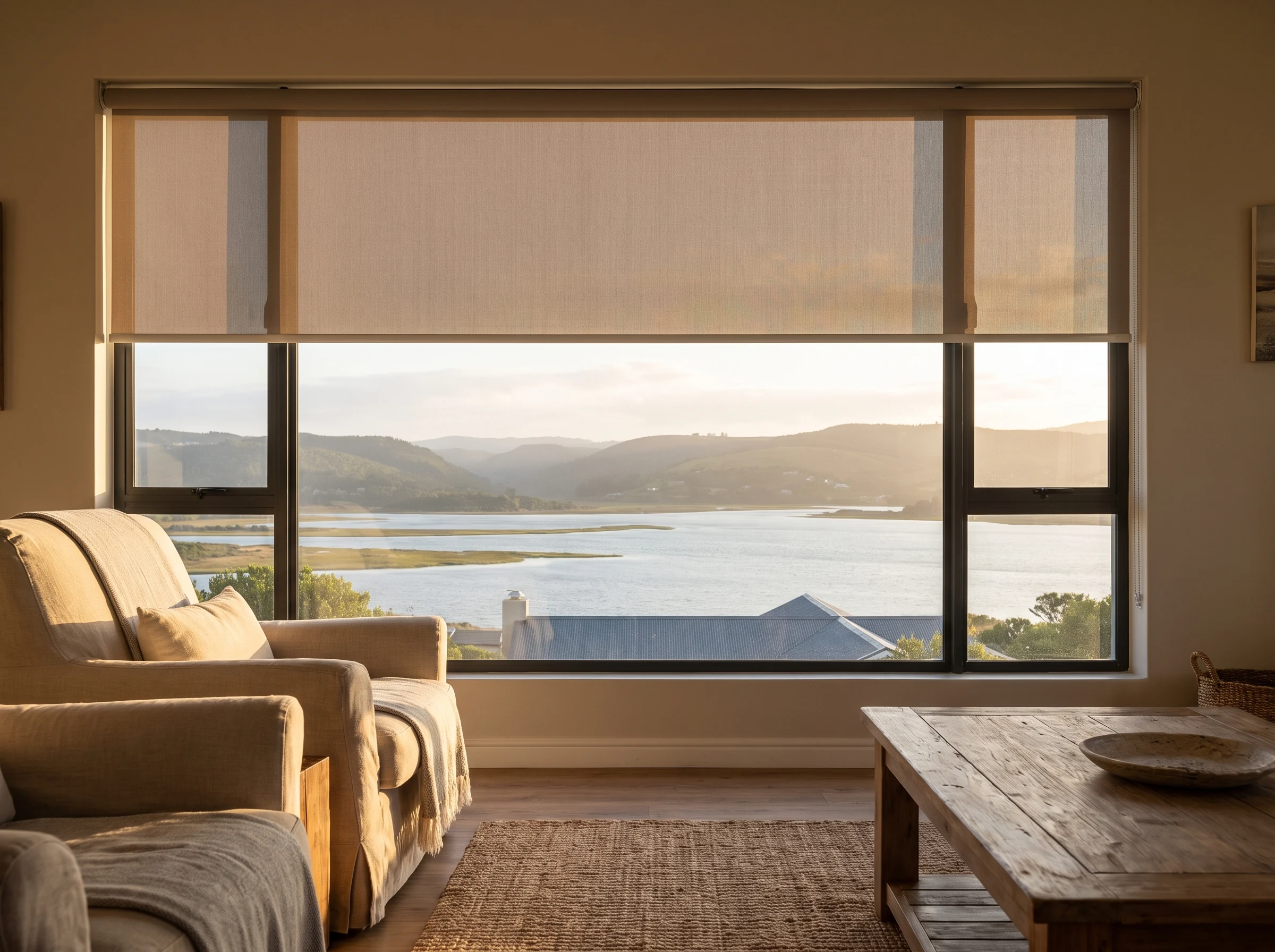
A shading guide written as a drive along the N2 — Mossel Bay, George, Wilderness, Sedgefield — because on this corridor the specification changes every forty kilometres, and the one thing that never changes is that it can rain tomorrow.
The corridor's standing condition: a view that is half forest, half water, and rarely completely dry.
Everything below is in a single PDF if you would rather save it than scroll.
Before you set off
A coast with no off-season
Almost every piece of shading advice published in this country assumes one of two weather patterns: a highveld summer where the rain arrives in thunderstorms between October and March, or a Cape winter where it arrives in fronts between May and August. The Southern Cape sits between those two systems and belongs to neither, which is why so much generic advice lands badly here.1
The numbers make the point better than adjectives do. George records roughly 657 mm of rain a year, and the gap between its driest month and its wettest is small — around 43 mm in June against about 75 mm in November.2 Rain is well distributed through the whole year, thinning only slightly from May to August.1 There is no three-month window when a house dries out properly, and there is no season you can point at and say "we'll sort the outside stuff then."
That single fact reorders the priorities. On a dry-summer coast you specify for glare first and worry about weather second. Here you specify the hardware first — coatings, fixings, cassettes, drainage — and choose the fabric afterwards, because the fabric is rarely what fails.
The sun, at least, is predictable
The corridor runs close to 34° south. Working the standard solar geometry for that latitude gives four numbers worth keeping in your head:3
At midsummer the noon sun stands about 79° above the horizon — almost straight down, so an eave earns its keep.
At midwinter it reaches only about 33° at noon, due north, and looks straight in under that same eave.
In December the sun sets at roughly 241° — south of west, so the worst late glare arrives on the south-west face, not the true west one.
In June it rises near 61° and sets near 299°, both well north of the east-west line.
Read that against a corridor where the coastline itself swings from south-facing at Mossel Bay to south-east-facing past Sedgefield, and you can see why we refuse to give a house-wide answer over the phone.
Stop one
Mossel Bay: the salt end
Start at the western gate. Mossel Bay's front row faces open water with very little standing between it and the weather, and it is the driest, brightest and saltiest stretch of everything covered here. The combination is unusual: high UV load and airborne salt at the same time, without the forest cover that softens both further east.
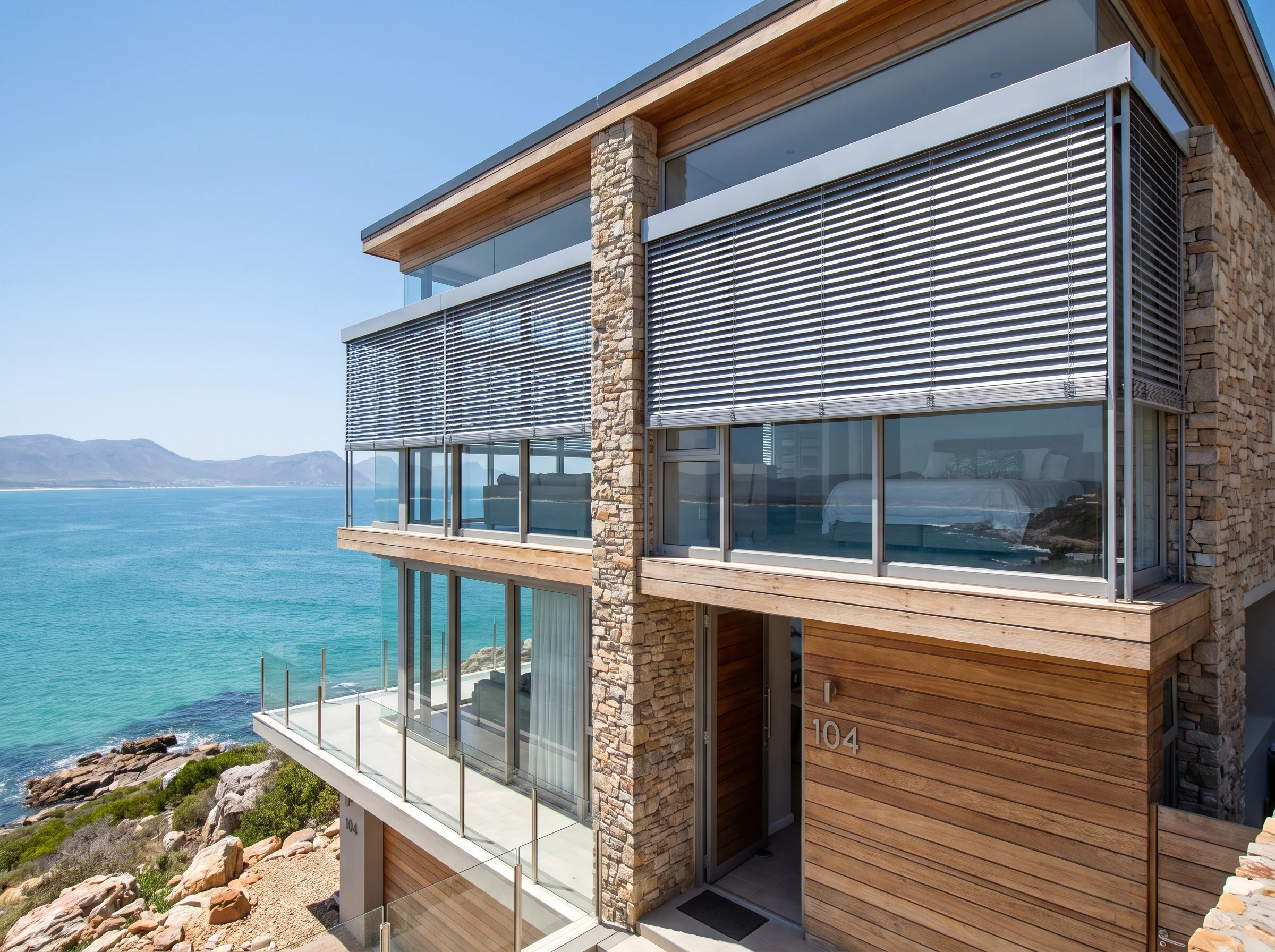
On a bay-front elevation the honest answer is to stop the sun outside the glass. An interior blind absorbs heat that has already come through the pane; the glass and the fabric then radiate it back into the room all evening. External venetian blinds sit in front of the glass and never let that happen, and because their slats tilt you keep a horizon and lose the burn.
Where we'd go further: for a west or south-west bedroom that also needs to be genuinely dark, a roller shutter does shading and blackout in one motorised system on the outside of the window. To be plain about it, these are shading shutters — sun, heat and glare. They are not security-rated shutters; that is a different product we quote separately if you ask.
Whatever goes up out here gets powder-coated aluminium and stainless fixings as the baseline, not as an upgrade. Salt does not attack the fabric first; it attacks the bracket, the chain and the screw.
Mossel Bay, upper storey: slats outside the glass, so the pane never gets a chance to warm.Stop two
George: behind the first ridge
Forty-odd kilometres on, the road runs into the lee of the first Outeniqua line and the brief changes. George is the corridor's comparatively dry anchor — still wet by national standards, still one of the better-watered towns in South Africa, but noticeably less relentless than the forest belt pressed against the escarpment.2
The town also carries two eras of window inside one municipal boundary. There is an old core with deep-set sash and casement openings built for thick walls, and there are newer estate homes built around stacking doors and tall panels. They are not the same measuring job and they are not the same specification.
Old-town openings: the reveal is usually deep enough for an inside fit, which keeps the joinery visible and leaves the facade untouched. Timber venetians are genuinely viable in George's drier, better-ventilated rooms if they carry a proper lacquer finish — this is the one town on the route where we'd suggest them without hedging.
Estate glazing: big north and west panels, little to shade them, and often a patio that wants to be usable at four in the afternoon. Sunscreen mesh keeps the mountain in the frame; a folding-arm awning covers the table outside it.
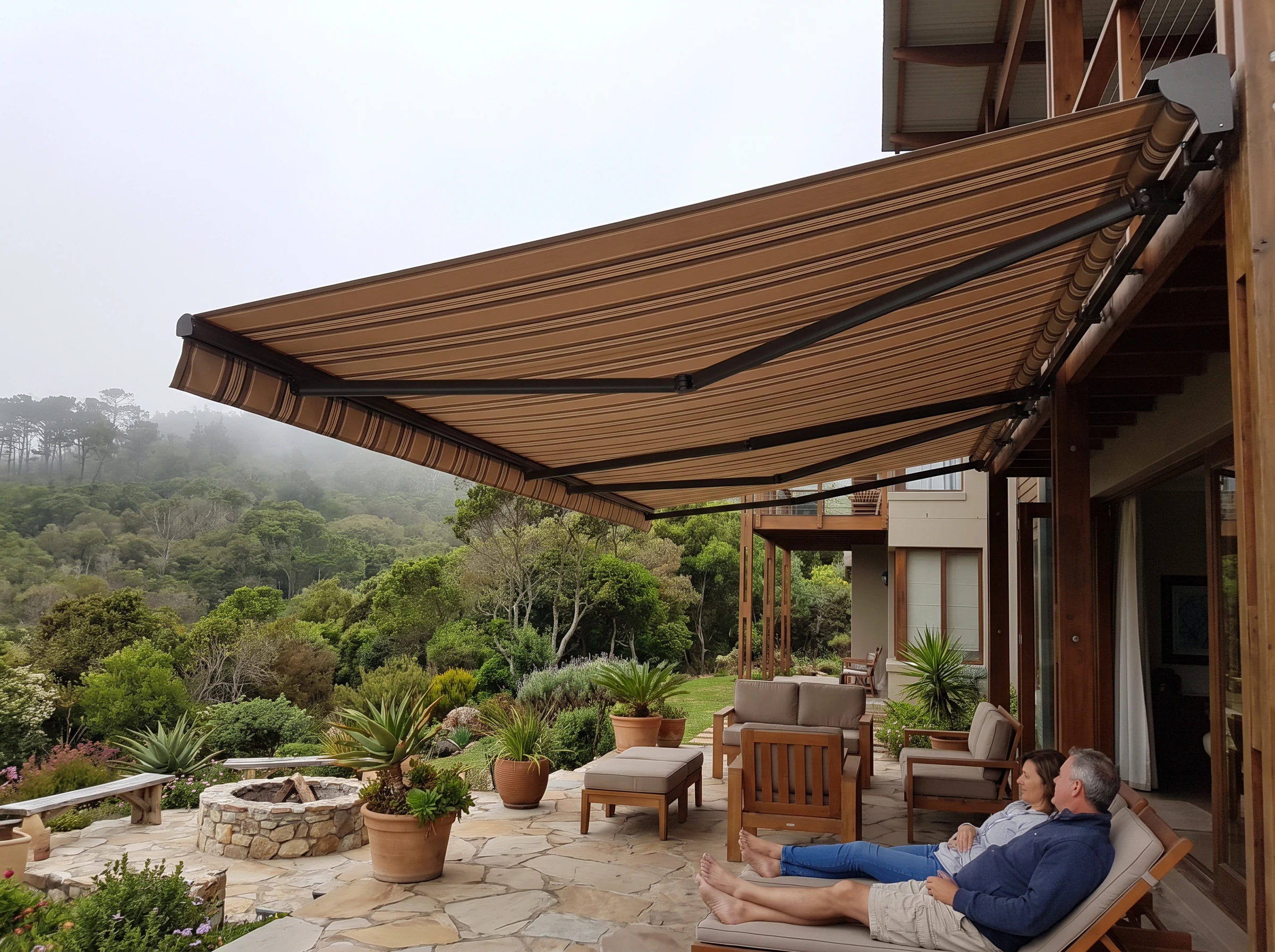
The awning caveat, honestly: a fabric awning on an open estate stand is a wind product before it is a shade product. Every motorised awning we fit on an exposed position carries a wind sensor that retracts it before a gust arrives. Without one, the first serious front decides the awning's lifespan for you.
George patio: shade while the sky is clear, folded away before the next front comes over the mountain.Stop three
Wilderness: mist until ten
East of George the mountains crowd the sea and the road runs through the wettest, greenest part of the drive. Mornings here often begin under low cloud that lifts somewhere mid-morning, and the light a room gets at eight is nothing like the light it gets at eleven. That daily swing, rather than raw brightness, is the real design problem.
It is the strongest argument on the whole corridor for a blind that has more than two states. Day and night banded fabric — alternating sheer and solid stripes on one roller — lets a lounge move from soft-and-open at breakfast to filtered-and-private by late morning without swapping products or hanging two blinds.
The dune frontage is a separate case
Homes on the exposed dune line take onshore wind almost undiluted, while houses set back against the lakes and forest get real shelter from the terrain. Two addresses ten minutes apart can honestly carry different hardware grades, and we would rather say so than sell the heavier spec to both.
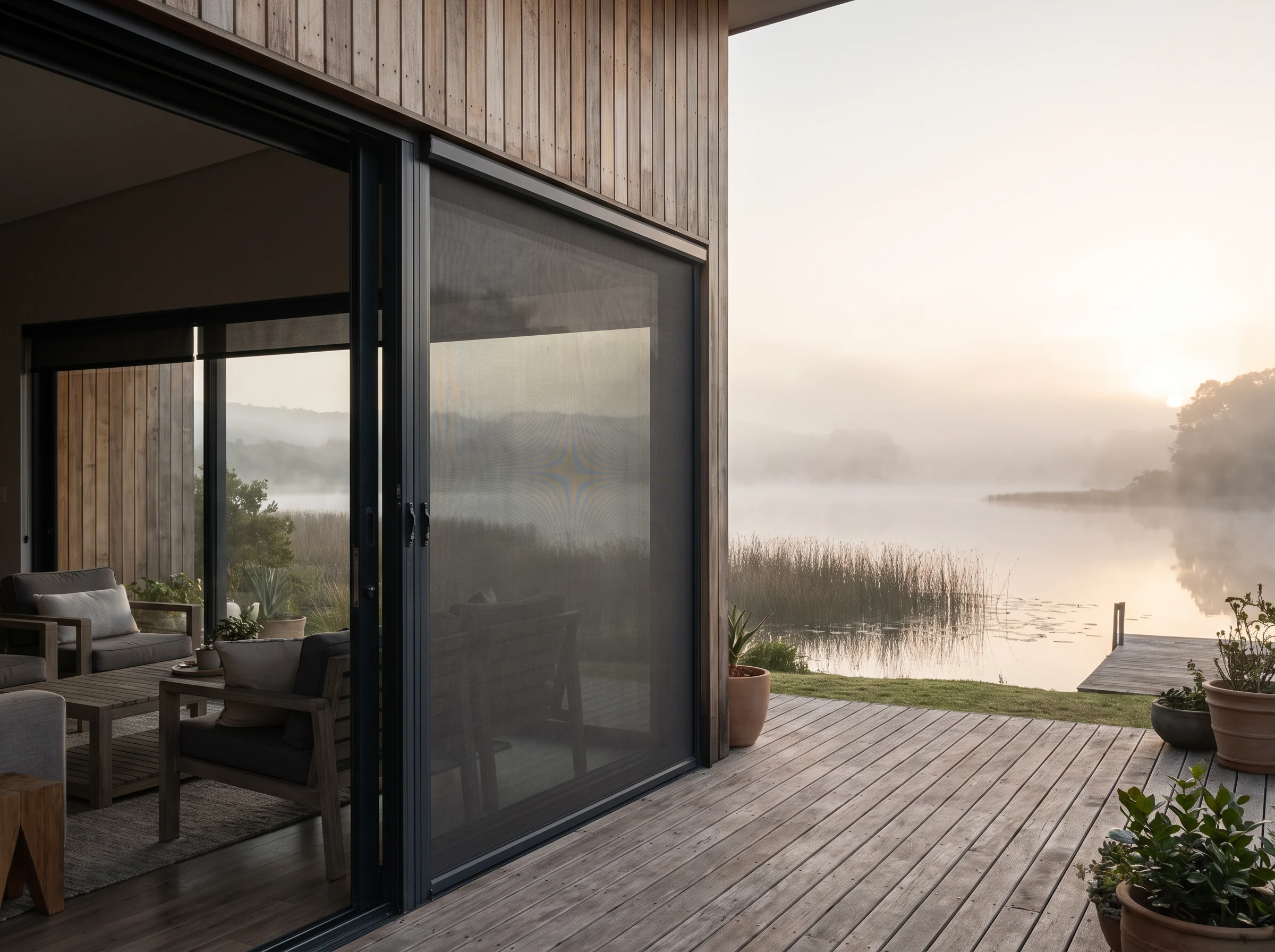
On a deck, a zip screen is the product that changes how often the deck gets used. Mesh running in captive side channels holds against wind instead of flapping in it, and it closes the space in against drizzle while the water view stays legible through the weave.
Wilderness deck: the mesh takes the wind off the table and leaves the reeds and the water where they were.Stop four
Sedgefield: the lagoon rooms
The last stop on this drive is built around water you can see from indoors. Swartvlei sits below the village, and the houses above it are almost all planned around one long glazed elevation pointed at it. That is a lovely thing to own and a specific problem to shade, because open water returns a second helping of light straight back up into the room.
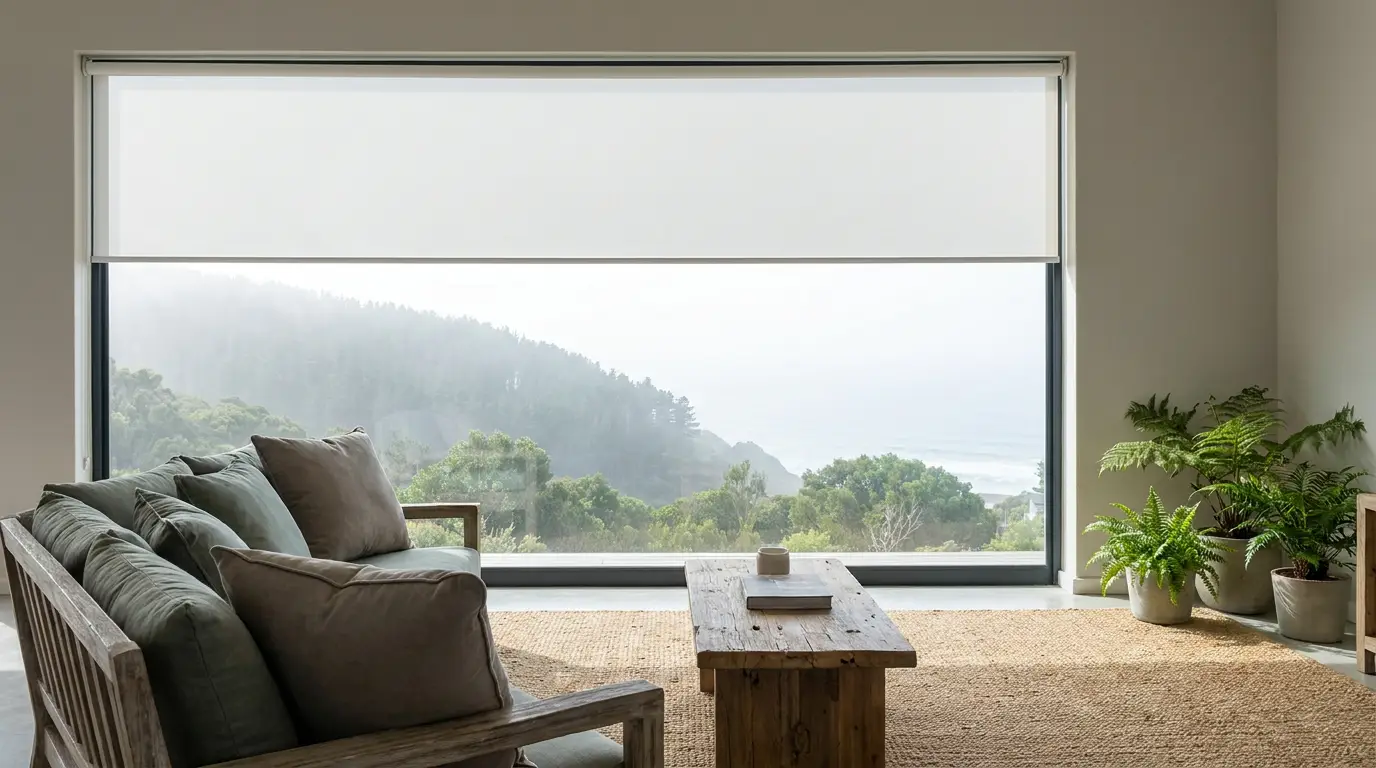
The instinct is to reach for blockout. It works, and it also switches off the exact thing the house was bought for. On lagoon-facing glass we would start with a sunscreen mesh — an open weave that drops the glare and the ultraviolet while the water stays visible through it — and keep blockout for the bedrooms behind.
The trade-off nobody should skip: a sunscreen mesh gives daytime privacy only. After dark, with the lamps on, it reverses and the lit room becomes the visible side. If a room needs both, a double roller answers it properly: mesh in front, blockout behind, on one bracket.
Where the lagoon elevation is a run of wide stacking doors rather than a window, vertical or panel blinds cover the whole span in one system without a seam every 1.8 metres, and they stack clear of the doorway when the doors are actually open.
Sedgefield: half down is usually the right answer — the glare goes, the lagoon stays.The whole route
What actually survives out here
Four towns, four different lighting problems — and one shared durability problem that outranks all of them. Here is what we specify because of it, and what we avoid.
Hardware
Powder-coated aluminium and stainless fixings anywhere within reach of the sea air. Sealed cassettes on exterior systems so the tube is not sitting in wet air all winter.
Fabric
Solution-dyed and coated fabrics, where the colour is part of the fibre rather than printed on it. They hold up to constant damp and constant UV far better than surface-dyed cloth.
Timber
Real wood only where a room is drier and genuinely ventilated, with a proper lacquer finish. Kitchens, bathrooms and lagoon-facing rooms get aluminium slats instead.
Motors
Wind sensors as standard on anything exterior and exposed. On sheltered stands we will tell you honestly that you can spend the money elsewhere.
One insulation note, with its limit stated
Cellular honeycomb blinds trap a layer of still air against the glass, and in a corridor where winter mornings are cool and damp that makes a real difference to a nursery or a room over a garage. What they will not do is dry a room out. If condensation is running down the inside of the pane, the answer is ventilation and heating, and a blind is at best a partial help — we would rather say that than sell you one as a damp cure.
And one thing we simply will not claim
Nothing we fit is maintenance-free on this coast. Exterior tracks want rinsing, hinges want the occasional wipe, and a blind that lives outside in salt air has a shorter life than the same blind inland. Any supplier who tells you otherwise has not worked here through a wet August.
Before you order anything
Three things only a measure settles
Everything above is genuinely useful groundwork, and none of it replaces standing in the room. Three questions in particular cannot be answered from a photograph or a phone call.
Which way does the room actually face? Houses on this corridor are turned toward the view, not squared to the street. A compass on the sill at the measure settles it in ten seconds and changes the specification more than the suburb name does.
Is the deck sheltered, or does it just look sheltered? Terrain does a lot of quiet work here. A stand tucked behind a dune or a treeline may not need the heavy exterior spec its neighbour on the open frontage does, and that is a real saving we would rather hand you than keep.
How deep is the reveal? An inside fit sits neatly in the joinery and leaves a hairline of light down each edge. A face fit is meaningfully darker and covers the frame. There is no free option — only the one that suits the room, decided at the window.
That is what the free in-home measure is for. It costs nothing, it carries no obligation, and it produces a written quote per window rather than a lump sum for the house.
Your turn
Book the measure that ends the guesswork
Fill this in and one of our expert consultants will contact you shortly to arrange your free in-home measure — anywhere along the corridor, from Mossel Bay to Sedgefield.
→
Bring this guide with you
Tell the consultant which stop on the drive sounds like your house — it saves a full conversation on the day.
→
Nothing quoted sight-unseen
The measure comes first and the quote comes after it. Nobody guesses a figure down the phone.
NOAA Global Monitoring Laboratory — Solar Position Calculator. Noon altitude and solstice sunrise/sunset azimuths quoted here are standard solar geometry for latitude 34° S and can be reproduced for your own address. gml.noaa.gov/grad/solcalc/
SANParks — Garden Route National Park, on the forest, lake and estuary systems along this stretch of coast. sanparks.org/parks/garden-route
Garden Route District Municipality — Climate Change Adaptation Needs and Response Assessment (2024), the district's own account of its rainfall and humidity profile. gardenroute.gov.za (PDF, 2024)